
Types of HVAC Systems in Apartments
The six common heating and cooling setups in apartments, how to recognize yours, what renters can safely check, and what owners should know.
Key points
- Know which of the six system types the apartment has.
- Do the four safe checks before calling anyone.
- Leave refrigerant, gas and electrical work to a licensed technician.
Apartments use six common heating and cooling setups. No single setup is right for everyone: the answer depends on the building, on who pays the bills and on whether you rent or own. This guide describes each type, how to recognize it, and what it means for you as a renter or an owner.
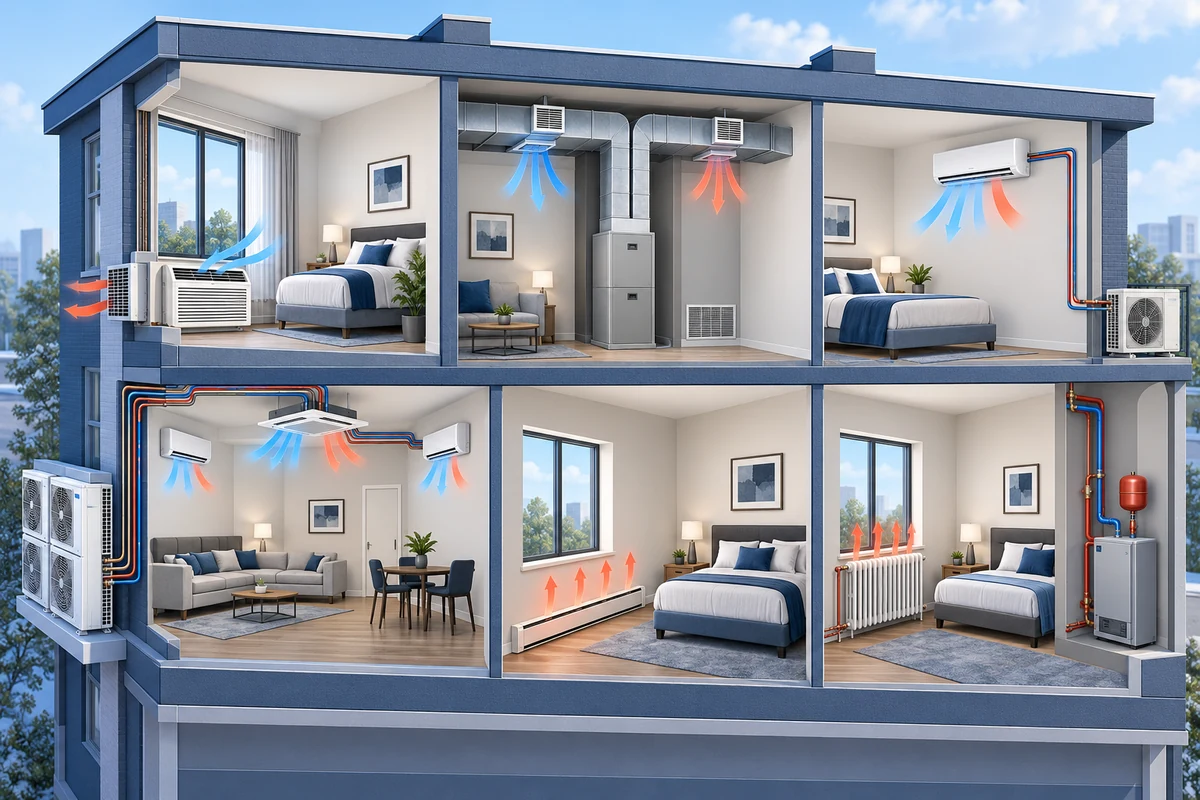
The six common setups at a glance
| System | How it works | Typical in | What to know |
|---|---|---|---|
| PTAC | A single box in the wall contains the cooling and heating, with the compressor inside the room | Older apartments, studios | Simple and inexpensive to replace, but it hums because the compressor is in the room |
| Central HVAC | One furnace or heat pump and a duct network serve the whole apartment | Larger units and newer buildings | Quiet and even, with vents instead of visible equipment |
| Ductless mini-split | One outdoor unit serves one or more slim indoor wall units | Retrofits, small apartments | Quiet, heats and cools, one unit per room |
| VRF | One large outdoor unit serves many indoor units across the building | High-rises and new construction | Efficient at building scale; a building-level decision, not an apartment-level one |
| Electric baseboard | A heated element in a metal strip along the wall | Older studios, additions | Silent and cheap to install, but electricity-heavy to run |
| Hydronic radiator | A central boiler sends hot water or steam to radiators | Pre-war buildings, buildings with a shared boiler | Warm and quiet; cannot cool; works only when the boiler runs |
1. PTAC: the through-the-wall unit
A PTAC is the self-contained metal box under the window. The whole machine, compressor included, sits in the wall, so you hear it in the room. It cools and heats one room, and each unit has its own controls.
- Good: it is simple, and a failed unit can be swapped for a new one without touching the rest of the building.
- Not so good: it is noisy, it takes up wall space, and its running cost follows the electric or fuel rates of the building.
2. Central HVAC: one system, shared ductwork
A central system separates the loud parts (outside or in a machinery room) from the air movement inside. Warm or cool air reaches each room through wall, floor or ceiling vents. Comfort is even and quiet, and the equipment is out of sight.
- Good: even temperature, quiet rooms, one filter and one system to maintain.
- Not so good: the whole apartment often works on one thermostat; leaky or poorly balanced ducts mean some rooms never feel right; and repairs are a building-level matter.
3. Ductless mini-split
A mini-split connects an outdoor unit to one or more indoor units through refrigerant piping. Indoor units serve rooms or zones. Heat-pump models heat and cool; cooling-only models do not provide heating.
- Good: quiet, no ductwork, individual control per room, and it fits apartments that never had ducts.
- Not so good: the indoor unit is always visible, and installing the outdoor unit needs a suitable outside wall and the building’s approval.
4. VRF: variable refrigerant flow
VRF is the building-scale version of the mini-split idea. One large outdoor unit, usually on the roof, serves many indoor units across apartments, each controlled separately. It is a system the building owner chooses and maintains, so renters simply live with it, and owners weigh it at construction or major renovation.
5. Electric baseboard heaters
A long metal strip along the wall holds a heating element. Air rises through it naturally, so there is no fan and no noise. Each room usually has its own thermostat.
- Good: silent, cheap to install and easy to control room by room.
- Not so good: electric resistance heat uses more electricity than a heat pump for the same warmth, so a cold winter shows up on the electric bill. The strips also need clear space in front of them.
6. Hydronic radiators
Older buildings heat with hot water or steam from a central boiler. The radiators stay warm for a while after the boiler stops, and the heat is gentle and quiet. The system cannot cool, and when the boiler is off for maintenance there is no heat anywhere in the building.
How to recognize your system
You can usually identify your system without opening any panels.
| If you see or hear this… | You likely have a… |
|---|---|
| A metal box under the window that hums when it runs | PTAC |
| Vents in the wall or floor, no visible equipment in the room | Central HVAC |
| A slim white unit mounted high on the wall with a remote | Ductless mini-split |
| A long metal strip along the baseboard | Electric or hot-water baseboard; confirm with the building manager |
| Standing metal radiators that click or hiss | Hot-water or steam radiators; confirm the type before service |
If the unit still will not run after the renters’ safe checks below, stop there. The next step belongs to a technician.
Renters: how to arrange service
Report the problem to the landlord or property manager using the building’s repair process. Describe what the unit does, when it started and what the thermostat shows. Have them arrange qualified service for refrigerant, gas, electrical or internal equipment work. Responsibility for arranging and paying for repairs depends on the lease and applicable local requirements.
Repair or replace
Apartment equipment follows the same repair-or-replace logic as a house: the fault, the parts, the access and the age of the system. For building-wide systems, size and access to roofs or machinery rooms matter too — our guide on what HVAC repair costs and what drives the price explains the main points.
Sources
- Carrier: Ductless air conditioners and heat pumps · Checked October 2026
- ENERGY STAR: Maintenance checklist · Checked October 2026
Need help with this?
commercial HVAC serviceOur commercial HVAC service page describes the work and how to book it. We assess the system, explain what we found and provide a written quote for approval before work begins.


